Our team operates a TV mounting company that has completed thousands of installs across nine US metro areas since 2015. Of everything we run, this is the hustle with the best ratio of revenue to sweat: indoor work, one-trip jobs, flat rates, and a tool kit that fits in a backpack.
It is also the hustle where a careless hour can drop a $2,000 television onto a hardwood floor. This guide covers the pricing that works, the tools that prevent disasters, and the wall types that separate professionals from apology letters.
Why TV mounting is a great skills-based hustle
- Jobs are short and predictable. A standard drywall-over-wood-studs mount takes a practiced installer under an hour. You can stack three or four in an evening after work.
- Flat rates are accepted without blinking. Customers already expect a fixed price by TV size. No haggling, no hourly suspicion.
- The tools are cheap relative to the revenue. A complete professional kit costs $300 to $600 if you already own a drill. It can pay for itself inside a week of evening jobs.
- Demand renews itself. Every moved apartment, every Black Friday TV, every finished basement generates installs. Q4 into January is a sprint.
The catch: precision matters more than strength, and the failure mode is expensive. This is a hustle for careful people.
What we actually charge
This is our company’s current published flat-rate ladder. It has survived thousands of installs and nine metro markets, so you can treat the structure as proven even if your local numbers land differently:
| Service | Our price |
|---|---|
| Basic mount, TV up to 54 inches | $129 |
| Large TV, 55 to 69 inches | $159 |
| Extra large, 70 to 79 inches | $209 |
| XXL, 80 inches and up | $255 |
| In-wall cable concealment | $95 per TV |
| Brick, stone, or masonry surcharge | +$95 per TV |
| Full-motion mount add-on | +$72 |
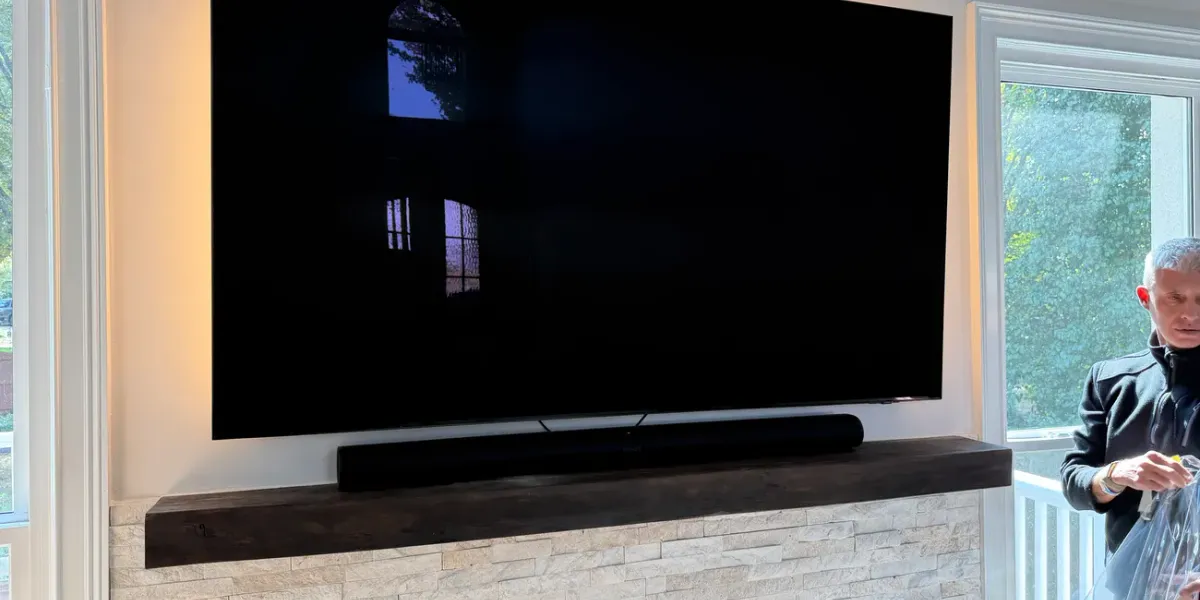
| Soundbar mounting | $79 |
Notes on how that ladder behaves in the real world:
- Size tiers are about risk and crew, not minutes. An 85-inch panel is a two-person lift with zero margin for error. Price the risk, not just the time.
- Concealment is the profit kicker. In-wall cable hiding adds $95 for roughly 30 to 45 minutes of practiced work, and most customers say yes once they see the dangling-cable alternative.
- Masonry pays a premium because it should. Drilling brick or stone needs a hammer drill, masonry anchors, and confidence. Beginners should decline fireplace jobs until they have practiced. More on that below.
- The average ticket climbs with add-ons. Mount plus concealment plus a soundbar turns a $159 job into a $333 job in the same visit.
The tool kit
Six tools do almost every job. We keep the full list with our specific picks in the TV mounting tool kit guide, but the short version:
- A multi-sensor stud finder. The single most important tool in the bag. Cheap single-sensor finders lie, and a mount anchored into nothing is how TVs meet floors.
- A magnetic stud finder as the cross-check. No batteries, finds the drywall screws, confirms what the electronic finder claims.
- A wall scanner with live-wire detection. Drilling into a hidden cable turns a $159 job into an electrician’s invoice. Scan before every hole.
- A drill with clutch control plus a proper bit set. Over-torqued lags strip out of studs; the clutch is the safety net.
- A digital level. A TV that is 1 degree off reads as crooked from the couch every single day. Digital beats bubble for this.
- A universal TV hardware kit. Half of all TVs arrive missing the right screws. The $15 hardware kit turns a dead trip into a completed job. Ask us how many times this has saved a truck roll.
The wall types that eat beginners
Every mounting horror story starts with a wall somebody misread:
- Drywall over wood studs. The standard case. Lag bolts into the center of two studs hold hundreds of pounds. This is where you learn.
- Metal studs. Common in condos and new builds. Lags into thin steel do not hold; you need toggle-style anchors rated for the load, through the stud. If you feel the bit punch through and spin free, stop and rethink.
- Brick and stone. Hammer drill plus sleeve or wedge anchors into the brick body, not the mortar joints. Slow, dusty, and priced accordingly.
- Plaster and lath. Older homes. Studs hide behind a crumbly layer that lies to cheap stud finders. Pilot holes and patience.
- The one to walk away from: anything where you cannot confirm structure. “It is probably fine” is not a mounting plan. Declining a job costs a fee; a fallen TV costs a reputation.
Practice sequence we recommend: your own wall first, then friends and family TVs at cost of hardware, then paid work. Ten careful installs make you competent; a hundred make you fast.
Getting the first customers
The playbook mirrors any local service, with two mounting-specific twists:
- Marketplace listing platforms work here. TV mounting is one of the most-searched tasks on handyman marketplaces. Standard rates and same-week availability get traction fast, and the platform reviews transfer credibility to your own site later.
- Deliver-day partnerships. Furniture and TV retailers, apartment leasing offices, and movers all meet people on the exact day the TV needs a wall. A stack of cards and a referral cut turns them into a pipeline.
Beyond that: Google Business Profile with photos of clean installs and hidden cables, neighborhood groups after each job, and asking for the review while the customer is still admiring the wall.
Mistakes we made so you can skip them
- Trusting the mount’s included hardware. The bag of bolts taped inside the box is a lottery. Carry your own hardware kit, always.
- Skipping the pre-lift function check. Power the TV on before it goes on the wall. Otherwise the dead panel that arrived dead becomes your fault.
- Eyeballing height. Center of screen at seated eye level for a normal room, roughly 42 inches to center. Over fireplaces, everything changes, and so should your price.
- Free repositioning. “Can you move it two inches left” after the lags are set is a new install. Confirm placement with painter’s tape before drilling and get a verbal yes.
- Not photographing the finished work. The portfolio is the marketing. Wide shot, cable detail, level check on screen. Every job, every time.
Common questions
Do I need to be licensed? A basic business license in most cities, yes. TV mounting generally does not require a trade license, but in-wall electrical work (adding an outlet behind the TV) does in most places. Partner with an electrician for those or use code-compliant in-wall power kits and know your local rules.
What about insurance? Non-negotiable, same as every hustle we cover: general liability at $40 to $90 a month. You are drilling into walls you did not build, near televisions you did not buy.
Can this scale past me? Yes. Ours did: flat-rate pricing, a repeatable tool kit, and a booking system are exactly the ingredients that let you put a second installer in a second truck. The guide you just read is, structurally, the training manual.
TV mounting or pressure washing first? Indoor versus outdoor, precision versus endurance, evening jobs versus weekend blocks. Read the pressure washing guide and pick the one that fits your week. Plenty of operators run both: washing in daylight, mounting after dark.
Questions we missed? Send them in and we will work the answers into this guide.